Many people come to therapy because they want to understand themselves better.
In my work with clients, I often meet people who have done a lot of thinking, reflecting and talking already — but still feel that something remains held in the body.
They want to make sense of their anxiety, grief, stress, trauma, overwhelm, or disconnection. They may have spent years thinking about what happened, why they feel the way they do, and how their past continues to affect the present.
Talking can be powerful. Words can bring clarity. They can help us organise experience, name feelings, and feel less alone.
But sometimes, words are not enough.
Not because talking therapy has failed.
Not because the person has not tried hard enough.
Not because they lack insight.
Sometimes the body is still carrying something that words alone have not reached.
When understanding does not change how you feel
A person may understand why they are anxious, but their body still tightens.
They may know they are safe, but their nervous system still reacts as though danger is close.
They may understand their grief, but still feel physically heavy, numb, restless, or disconnected.
They may have spoken about what happened many times, but something still feels held in the body.
This can be frustrating. People often say things like:
“I know all this already, but I still feel it.”
“I understand it in my head, but my body has not caught up.”
“I can explain what happened, but I do not feel any different.”
These statements matter. They tell us something important: healing is not only cognitive. It is not only about understanding. It is also about the body finding a new experience of safety, contact, regulation and support.
This is where Clay Field Therapy® can offer something different — a body-based therapy available in Nuneaton, Warwickshire, that works through touch, pressure, movement and sensory contact rather than relying only on words.
The body speaks through movement, pressure and touch
Before we speak, we experience the world through the body.
A baby reaches, grasps, pushes, pulls, curls, rests and protests long before they can explain what they feel. Children often show us through movement what they cannot yet say in words. Young people may communicate through posture, rhythm, silence, avoidance, intensity, or restlessness. Adults, too, carry patterns in the body that may have formed long before they had language to describe them.
The body does not only remember events. It remembers ways of responding.
It remembers bracing.
It remembers reaching.
It remembers holding on.
It remembers giving up.
It remembers protecting itself.
It remembers searching for support.
In Clay Field Therapy®, these bodily responses are not treated as problems to be talked away. They are given space to be noticed, expressed, organised and transformed through contact with clay.
What happens at the clay field?
Many people are surprised by how quickly the hands begin to show something. A movement, a pressure, a pause, a grip, a smoothing gesture — something begins before the person has fully explained it.
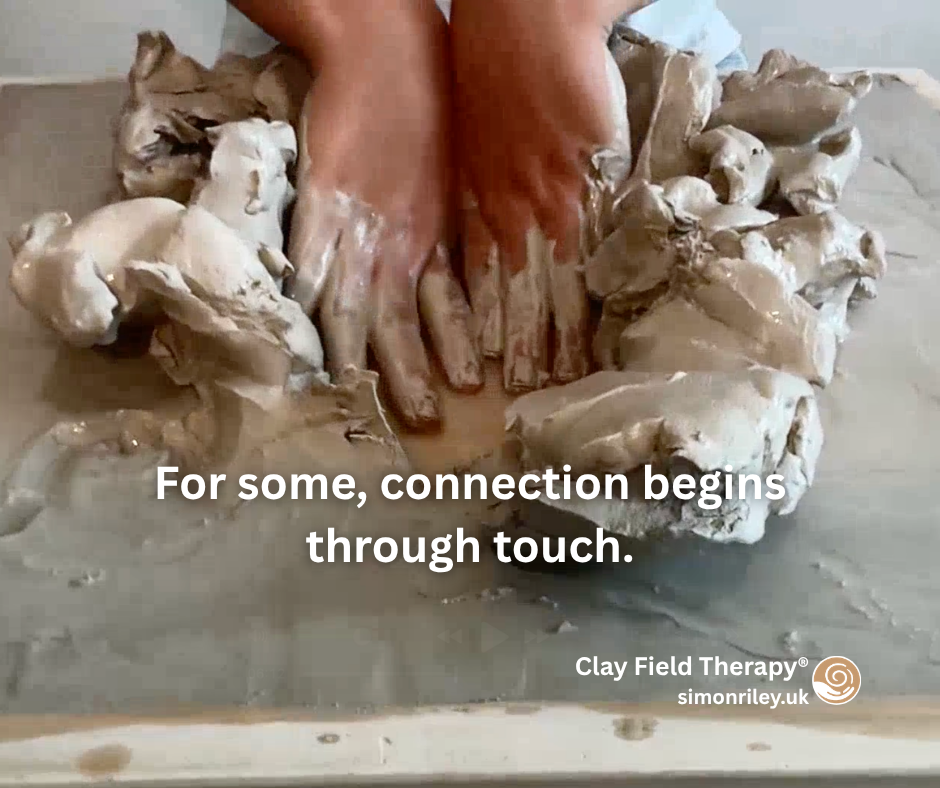
Clay Field Therapy® uses a simple wooden box filled with clay. There is usually water available. The person sits at the field and begins to explore through their hands.
There is no need to make an object.
There is no need to be artistic.
There is no need to know what to say.
The focus is not on producing something beautiful or meaningful. The focus is on the process.
The hands may press, smooth, dig, gather, push, grip, stroke, splash, hold or pause. The clay responds. It offers resistance, texture, weight, softness and boundary. The person receives immediate feedback through the hands and body.
Something begins to happen through touch.
For some people, this is calming.
For others, it brings energy.
For some, it reveals frustration or uncertainty.
For others, it allows a quiet sense of contact to return.
The clay field gives the body somewhere to begin.
Why this can help children and young people
Clay Field Therapy® can be especially meaningful for children and young people because it does not require them to explain everything verbally before help can begin.
Children may not have the language for what they feel. Young people may have the language but not want to use it directly. Some may feel exposed by face-to-face conversation. Others may have experiences that are too confusing, too early, or too emotionally loaded to put into words.
At the clay field, the pressure is different.
A child can explore.
A young person can stay with the material.
The hands can lead before words are required.
This does not mean there is no therapeutic depth. In fact, the depth often comes because the body is allowed to communicate in its own way.
Through clay, children and young people may begin to discover boundary, strength, softness, control, release, rhythm, repair and support. These are not abstract ideas. They are experienced physically.
For children who feel overwhelmed, anxious, shut down, angry, uncertain, or disconnected, this kind of body-based therapy can offer a powerful alternative to having to explain everything verbally.
For parents looking for therapy for children or young people in Nuneaton, Warwickshire and the wider Midlands, this can be reassuring: the child does not need to perform, produce artwork, or find the perfect words.
Why this can help adults too
Adults can also benefit from therapy that does not begin with talking.
Many adults have become very skilled at explaining themselves. They may know their history, their patterns, their attachment style, their trauma responses, or their coping strategies. But insight does not always bring regulation. What they are looking for is not another explanation, but a different experience.
Sometimes adults need an experience rather than another explanation.
At the clay field, an adult may begin to notice how they approach contact, pressure, resistance, control or support. They may discover how difficult it is to let the clay hold weight. They may notice a need to smooth everything over, to keep control, to avoid mess, or to press with force.
These movements are not judged. They are followed with curiosity.
The work is not about interpreting the clay. It is about noticing what happens in the person as they meet the material.
Sometimes a person finds a hold.
Sometimes they find a boundary.
Sometimes they find movement.
Sometimes they find rest.
And sometimes, something that has been held tightly for a long time begins to shift.
Therapy does not always have to start with a story
There is a common belief that to heal, we must first tell the story.
Stories can be important. But some stories are not ready to be told. Some are not stored neatly in words. Some are held in sensation, gesture, posture, breath and touch.
Clay Field Therapy® respects this.
It does not force the person to speak before they are ready. It does not require a clear narrative. It does not ask the person to explain what they do not yet understand.
Instead, it offers a safe, contained space where the hands can begin.
This can be a relief.
For some people, the most honest starting point is not “Let me tell you what happened.”
It is:
“I do not know what I feel.”
“I feel stuck.”
“I feel overwhelmed.”
“I cannot explain it.”
“I just know something is held in my body.”
That is enough.
A different route into regulation
Emotional regulation is often spoken about as though it is something we should be able to think ourselves into.
But regulation is bodily.
It involves breath, muscle tone, posture, rhythm, pressure, contact, safety and relationship. It is not simply a thought. It is a state the body learns through experience.
Clay Field Therapy® works directly with this.
The clay gives the hands something real to meet. The box gives boundary. The water introduces flow and change. The therapist offers presence, attention and safety. The person begins to find their own way through the material.
This is not about fixing someone. It is about supporting the body to discover new possibilities.
A hand that could only grip may begin to soften.
A body that felt collapsed may begin to find pressure.
A person who felt scattered may begin to gather.
A child who felt overwhelmed may begin to organise.
A young person who felt guarded may begin to explore.
These changes can be subtle. But they matter.
Clay Field Therapy® in the West Midlands
If talking therapy has helped but something still feels stuck, Clay Field Therapy® may offer a different place to begin.
I offer Clay Field Therapy® in the West Midlands for children, young people and adults, alongside workshops and supervision for therapists and helping professionals.
You do not need art skills.
You do not need experience with clay.
You do not need to know exactly what to say.
Sometimes words come later.
Sometimes the hands already know where to begin.
If you are curious about Clay Field Therapy® for yourself, your child, your young person, or your professional practice, you are welcome to get in touch.