There are moments in therapy when words are not enough.
Not because the person is unwilling.
Not because they are avoiding the work.
Not because they lack insight.
But because some experiences are held deeper than language.
They are held in the body.
In the hands.
In the breath.
In the muscles.
In the nervous system.
In the way a person reaches, resists, withdraws, pushes, grips, softens, or holds on.
This is one of the reasons I work with Clay Field Therapy®.
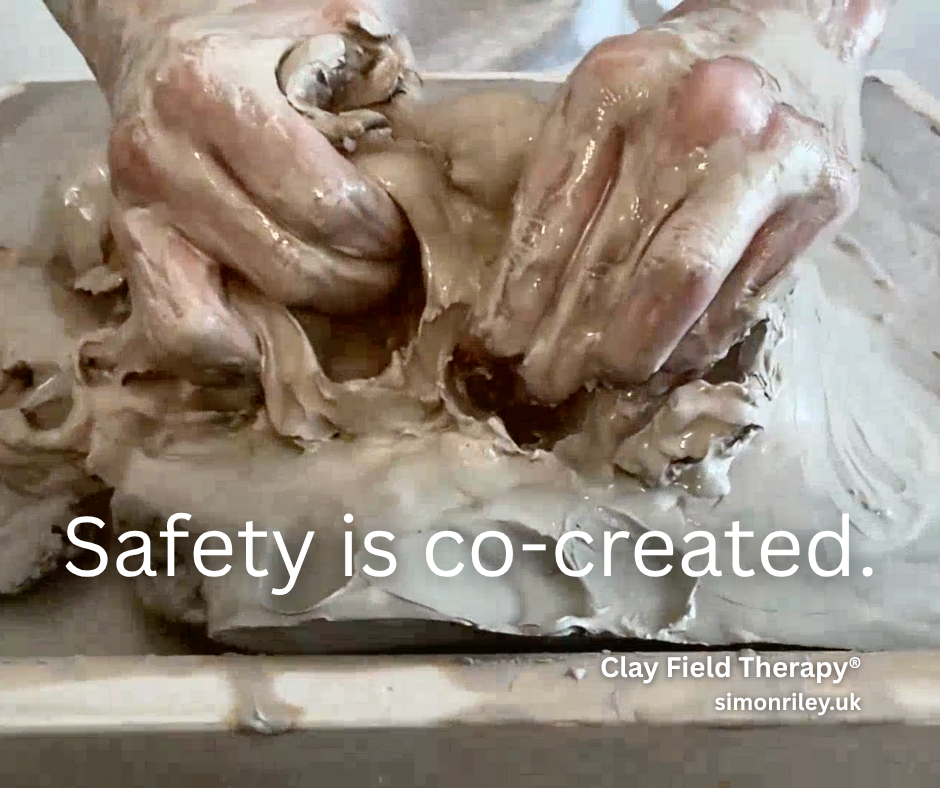
At the clay field, therapy does not begin with an explanation. It begins with contact.
A wooden box. Clay. Water. Hands.
No image has to be made.
No story has to be told.
No performance is required.
The person sits at the clay field and begins to explore. Sometimes slowly. Sometimes with pressure. Sometimes with uncertainty. Sometimes with great force. Sometimes with the smallest movement of the fingertips.
And somewhere in that encounter, something begins to speak, not through words, but through touch.
The body often knows first
In my therapeutic practice, I have become increasingly interested in the moments before language.
Before a person says, “I feel anxious,” the body may already be tightening.
Before someone says, “I feel overwhelmed,” the hands may already be searching for something firm.
Before someone says, “I need support,” the body may already be reaching for contact.
This is not separate from therapy.
This is therapy.
Clay Field Therapy® offers a way of listening to the body without forcing it to explain itself too quickly.
For many people, children, young people and adults alike, talking can sometimes feel like another demand. A child may not yet have the words. A young person may have learned to protect themselves by saying very little. An adult may have spoken about their experiences many times and still feel that something remains unresolved in the body.
Clay Field Therapy works with that “something” directly through touch, pressure, movement and regulation.
The clay gives resistance.
The water offers change.
The box gives boundary.
The hands begin to discover what is needed.
What is the self-found hold?
One of the most powerful moments I witness in Clay Field Therapy® is what I often describe as the self-found hold.
This is not something I give to the person.
It is not a technique I impose.
It is not a shape I instruct them to make.
It is a moment that emerges.
The hands may gather the clay.
They may press into it.
They may form a mound, a wall, a hollow, a firm edge, or a place to rest.
Sometimes both hands come together around the clay.
Sometimes one hand finds support from the other.
Sometimes the person discovers, almost with surprise, that they have created a hold that feels steadying.
The important part is not what it looks like.
The important part is what happens in the body.
A person may become quieter.
Their breathing may change.
Their shoulders may drop.
There may be a sense of “I can stay with this now.”
Something that felt scattered begins to gather.
Something that felt too much begins to find a boundary.
Something that felt lost begins to make contact.
This is why the self-found hold matters so much to me.
It is not simply symbolic.
It is not just a metaphor.
It is an embodied experience of finding support from within the encounter itself.
The person does not only talk about being held.
They discover holding through their own hands.
Why clay?
Clay is a very particular material.
It is soft, but it resists.
It can be shaped, but it also pushes back.
It can be broken, repaired, pressed, smoothed, dug into, gathered, flattened, soaked, dried, and changed again.
This makes clay deeply useful in body-based therapy.
When someone presses into clay, there is feedback. The body feels the pressure. The hands receive information. The nervous system begins to respond.
This is different from simply thinking about a problem.
In Clay Field Therapy®, the person is not asked to produce an artwork or explain the meaning of what they have made. Instead, the attention is on the lived experience:
What happens when the hand presses?
What happens when the clay resists?
What happens when water is added?
What happens when there is too much?
What happens when there is not enough?
What happens when the person finds their own rhythm?
These are not abstract questions. They are felt through the body.
For some people, this can become a route back to emotional regulation, safety, and self-connection.
Therapy without needing to talk
A common misunderstanding is that therapy must begin with words.
Words are important. They can help us understand, reflect and integrate. But words are not always where therapeutic work needs to begin.
For children, the body often communicates long before language can organise experience. A child may show through movement, pressure, repetition, withdrawal, rhythm or touch what they cannot yet explain. Young people, too, may carry experiences that are difficult to name, or may find direct conversation too exposing at first. Adults may understand their history intellectually and still feel anxious, overwhelmed, numb or disconnected in ways that words alone have not shifted.
Clay Field Therapy® offers another route.
It can be helpful for children, young people and adults who:
- feel overwhelmed, anxious or emotionally shut down
- struggle to explain what they feel
- have experienced stress, disruption or loss
- find talking difficult, tiring or insufficient
- need support with emotional regulation and sensory integration
- feel disconnected from themselves or from others
- are curious about body-based, non-verbal or sensory therapy
In my own practice, I do not see Clay Field Therapy as replacing talking therapy. I see it as offering access to another layer of experience: one that is especially important when language is not yet available, no longer enough, or not the safest place to begin.
Sometimes words come afterwards.
Sometimes they are not needed straight away.
Sometimes the body finds its way first.
My role as therapist
In Clay Field Therapy®, my role is not to interpret what someone makes.
I am not looking at the clay and deciding what it “means”.
I am not analysing the person’s movements from a distance.
I am not asking them to turn the experience into a neat story before it is ready.
My role is to stay present.
To notice.
To witness.
To support safety.
To pay attention to rhythm, pressure, contact, withdrawal, tension, breath, and change.
To help the person stay connected to their own process.
This matters because Clay Field Therapy can reach places that are tender, early, or difficult to name. The therapeutic relationship still matters deeply. The person is not left alone with the material. They are accompanied.
For me, this is where the work becomes both simple and profound.
The clay is not just clay.
The hands are not just hands.
The session becomes a field of relationship — between person, material, body, memory, sensation, and therapist.
A different kind of change
We often think change has to come through insight.
“If I understand it, I can change it.”
Sometimes this is true.
But sometimes change comes through experience first.
A person presses into the clay and discovers strength.
A person adds water and discovers softness.
A person gathers the clay and discovers boundary.
A person finds a hold and discovers steadiness.
A person clears the field and discovers release.
These moments may look small from the outside. But inside the body, they can be significant.
Clay Field Therapy® invites a person into direct experience. It gives the nervous system something concrete to work with. It allows the hands to search, test, resist, repair and find.
And sometimes, the most important moment is not dramatic at all.
It is the moment someone realises:
“I can feel myself again.”
Clay Field Therapy® in Liverpool
I offer Clay Field Therapy® in Liverpool for children, young people and adults.
For children and young people, the clay field can provide a developmentally sensitive, non-verbal space where the hands are free to explore, test, organise and find support through touch. For adults, it can offer a way into regulation and self-connection when talking alone has not been enough.
Clay Field Therapy may be of interest where there is:
- anxiety or overwhelm
- emotional shutdown or disconnection
- difficulty putting feelings into words
- early developmental or relational experiences that are hard to verbalise
- grief, stress or life disruption
- a wish to explore body-based therapy through touch rather than conversation alone
Sessions take place in person in Liverpool. You do not need any experience with clay. You do not need to be creative. You do not need to know what to say.
You only need a willingness to begin with your hands.
If you are a therapist, counsellor, play therapist, art therapist, educator, parent or professional working with children and young people, I also offer workshops and professional learning opportunities exploring Clay Field Therapy®, regulation, haptic development and the therapeutic use of clay.
An invitation
There is something deeply human about touching clay.
It is earth.
It is body.
It is resistance.
It is possibility.
In the clay field, the hands are given permission to search. Not to perform. Not to create something impressive. Not to explain everything.
Just to begin.
And often, that is where something changes.
If you are curious about Clay Field Therapy® in Liverpool — for yourself, your child, or your professional practice — you are welcome to get in touch.
Your hands may know where to begin.