Many people arrive at therapy with a great deal of insight.
They have reflected.
They have read.
They have listened to podcasts.
They may have already had counselling or psychotherapy.
They may understand their childhood, their relationships, their patterns, their anxiety, their grief, or their trauma responses.
And yet they still feel stuck.
This can be deeply frustrating.
A person might say:
“I know why I feel like this, but I still feel it.”
“I understand what happened, but my body still reacts.”
“I can explain it clearly, but I do not feel any different.”
“I know I am safe now, so why do I still feel anxious?”
These are not signs of failure. They are signs that understanding and regulation are not the same thing.
Insight can help us make sense of experience
Insight matters.
Being able to name what has happened to us can be powerful. Understanding patterns can reduce shame. Talking things through can help us feel less alone. For many people, counselling and psychotherapy offer a vital space to be heard, understood and accompanied.
But insight mainly works through meaning.
It helps us organise our story. It helps us understand connections. It helps us think, reflect and make sense of ourselves.
The body, however, does not always change just because the mind has understood.
Someone may know they are safe, but their nervous system may still behave as though danger is close. They may understand that a situation is different now, but their muscles still tighten, their breathing changes, their stomach drops, or their body prepares to protect itself.
This is because emotional experience is not only held in thoughts.
It is also held in the body.
The body may need a new experience
When something has been carried in the body for a long time, explanation alone may not be enough.
The body may need to experience something different.
It may need to feel pressure and support.
It may need to test resistance.
It may need to find boundary.
It may need to move, push, gather, release or rest.
It may need to discover safety through contact rather than simply being told that safety exists.
This is one of the reasons I work with Clay Field Therapy®.
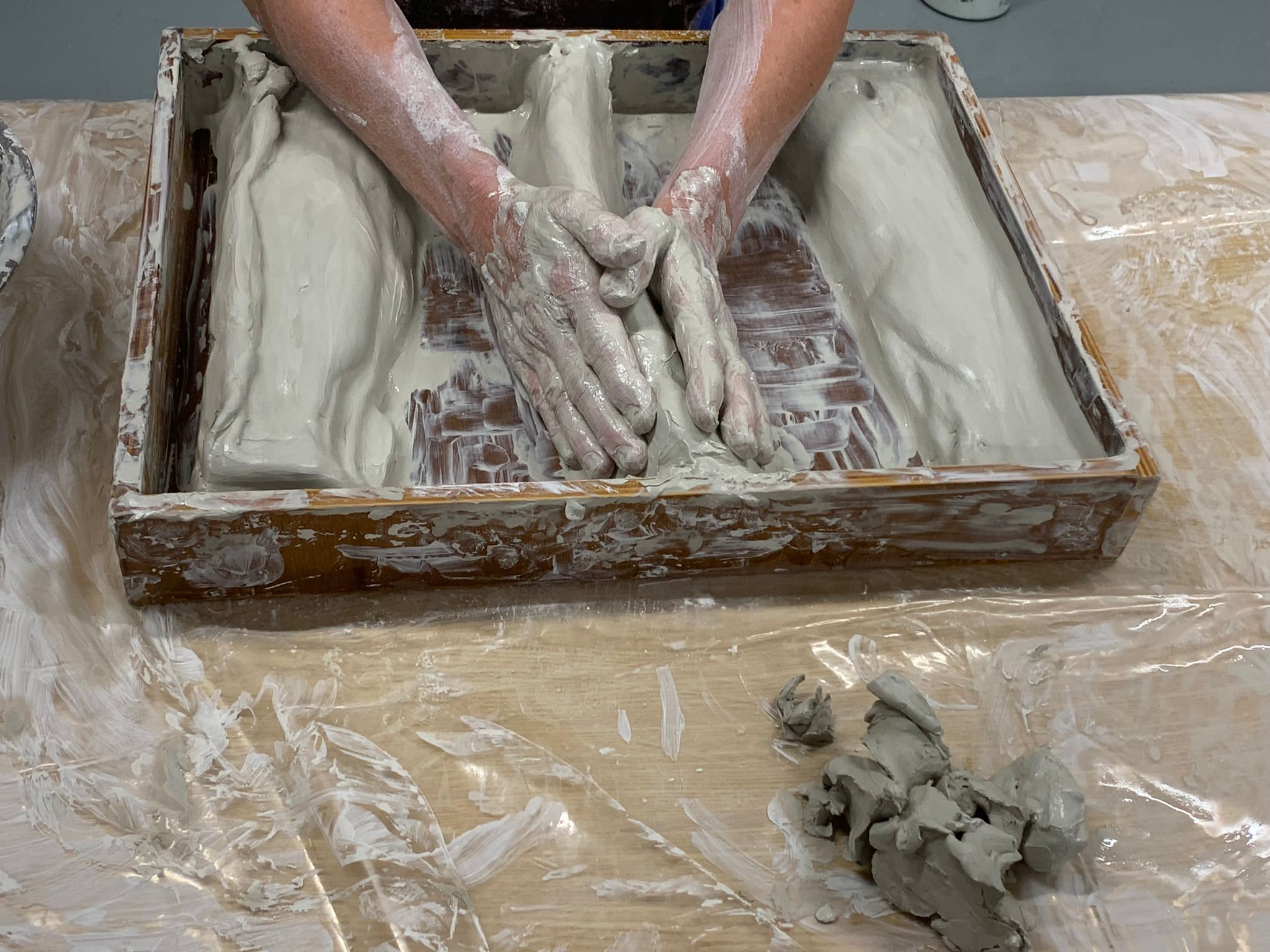
Clay Field Therapy® does not begin by asking someone to explain everything. It begins with the hands, the body, and a field of clay.
There is a wooden box.
There is clay.
There is water.
There is touch, pressure, movement and relationship.
The person does not need to make art. They do not need to produce an object. They do not need to know what to say.
The hands begin where words may have reached their limit.
Why the hands matter
The hands are deeply connected to how we meet the world.
We reach with our hands.
We protect ourselves with our hands.
We hold on.
We push away.
We explore.
We test.
We soothe.
We repair.
We make contact.
In Clay Field Therapy®, the hands are not just doing an activity. They are part of the therapeutic process.
A person may press into the clay and begin to feel their own strength.
They may smooth the clay and find rhythm.
They may dig, gather, push, hold, flatten, flood, repair or reshape.
They may discover what it is like to meet resistance and not collapse.
They may find a hold that feels steadying.
They may create a boundary where previously everything felt too much.
These moments can be subtle, but they are not superficial.
They offer the body a real, sensory experience.
The clay responds. The hands receive feedback. The nervous system has something concrete to work with.
Regulation is not just a thought
Emotional regulation is often spoken about as though it is a mental skill.
We may tell ourselves to calm down.
We may remind ourselves that everything is okay.
We may try to think differently.
Sometimes this helps.
But regulation is not only cognitive. It is bodily.
It involves breath, muscle tone, posture, rhythm, pressure, contact, safety and relationship.
This is why a person can know something logically and still feel something completely different physically.
The body may not be asking for more information.
It may be asking for a different experience.
Clay Field Therapy® offers a way to work with regulation directly through the body. The clay gives resistance. The box gives boundary. The water introduces change. The therapist offers presence and attention. The hands begin to search for what is needed.
For some people, this can open a different kind of therapeutic movement.
Not just, “I understand myself better.”
But:
“I can feel something changing.”
Children and young people often show this clearly
Children and young people can help us understand this very clearly.
A child may not be able to explain why they feel anxious, angry, overwhelmed or shut down. A young person may understand more than they can safely express. They may not want another adult asking direct questions. They may not have the words, or they may not trust that words will help.
But their body is communicating.
Through movement.
Through pressure.
Through avoidance.
Through silence.
Through energy.
Through tension.
Through play.
Through touch.
Clay Field Therapy® gives children and young people a way to communicate and regulate without needing to start with explanation.
They can meet the clay with their hands. They can test what happens. They can discover strength, softness, boundary, release and support through direct experience.
This can also be true for adults.
Many adults have words. Many adults have insight. But part of them may still need the kind of experience that words alone cannot provide.
When therapy becomes embodied
In my practice, I am interested in the point where therapy becomes more than talking about change.
I am interested in what happens when the body begins to participate.
When someone presses into the clay and realises they can use force.
When someone who usually holds everything together allows the clay to become messy.
When someone who feels scattered begins to gather the clay into one place.
When someone who feels overwhelmed finds an edge, a boundary, a hold.
When someone who has spoken about safety begins to feel something steady through their hands.
These are not dramatic performances. They are often quiet moments.
But they matter.
They show that the therapeutic process is not only happening in thought. It is happening through sensation, movement, contact and relationship.
You do not need to start with the right words
One of the gentle strengths of Clay Field Therapy® is that you do not need to arrive with a clear explanation.
You do not need to know exactly what is wrong.
You do not need to tell your whole story.
You do not need to be creative.
You do not need to be good with clay.
You do not need to know what you are going to experience.
You can begin with curiosity.
For some people, that is enough.
The hands may begin slowly.
The body may notice the texture.
The clay may offer resistance.
The water may change the field.
Something may begin to organise.
Words may come later. Or they may not need to come immediately.
The work begins with contact.
Clay Field Therapy® in Liverpool
I offer Clay Field Therapy® in Liverpool for children, young people and adults.
This work may be helpful if you feel that you understand yourself intellectually but still feel anxious, overwhelmed, shut down, disconnected or stuck in your body.
It may also be helpful for children and young people who find it difficult to explain what they feel, or for those who need a more sensory, body-based and non-verbal way to explore emotional regulation.
Clay Field Therapy® is not about making art. It is not about producing something impressive. It is not about having the right words.
It is about giving the body a different way to speak.
If you are curious about Clay Field Therapy® for yourself, your child, your young person, or your professional practice, you are welcome to get in touch through SimonRiley.uk.
Sometimes insight is important.
And sometimes the next step is not more explanation.
Sometimes the next step is experience.