Trying a new form of therapy can feel uncertain.
Many people are curious about Clay Field Therapy®, but hesitate because they simply don’t know what to expect from a first session.
- Will I have to talk?
- Will I have to make something?
- Will I know what to do?
- What if I feel awkward?
- What if my child does not want to speak?
- What if I am not creative?
These are very understandable questions.
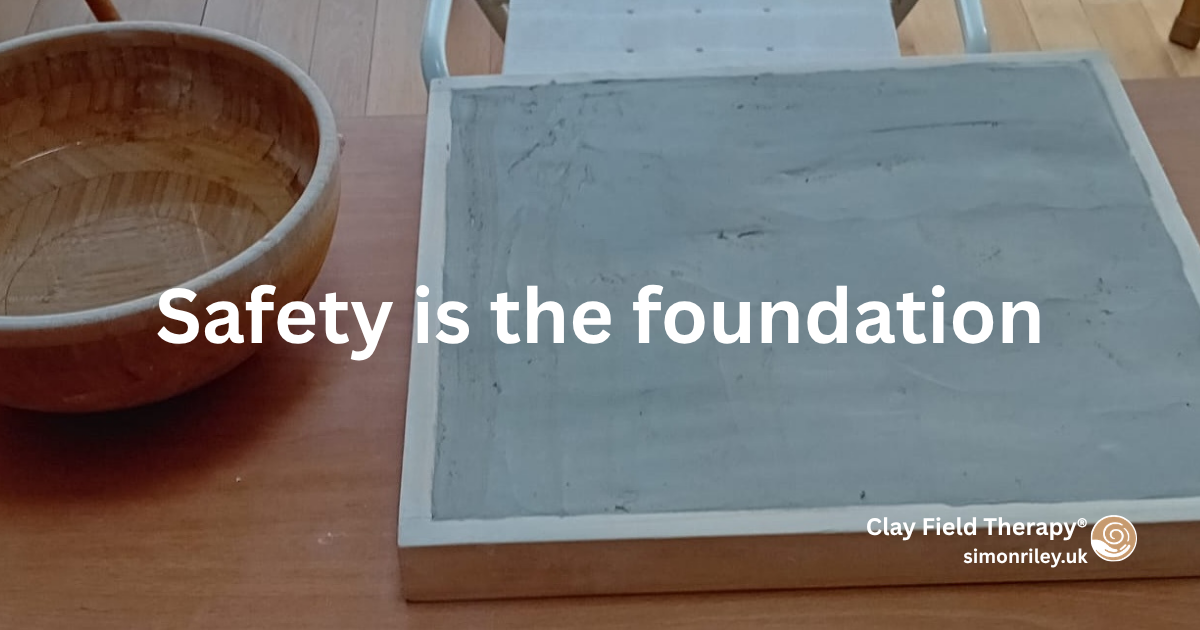
Clay Field Therapy® is different from many other forms of therapy because it does not begin with the expectation that you must explain everything clearly. It begins with a simple but powerful therapeutic setup: a wooden box, clay, water, hands, and a therapist who is present with you in the process.
There is no need to be artistic.
There is no need to make an object.
There is no need to know the right words.
The first session begins exactly where you are.
One of the things I often notice is how quickly people begin to relax once they realise there is nothing they need to achieve. There is no right way to use the clay, and no expectation to get it “right”.
Arriving at the clay field
In a Clay Field Therapy® session, you sit in front of a wooden box filled with clay. Water is available nearby.
The clay is not there so that you can make a pot, sculpture or finished artwork. It is there as a material your hands and body can meet.
You may begin by touching the clay.
You may press into it.
You may smooth it.
You may add water.
You may dig, gather, push, hold, flatten or pause.
You may simply notice the texture at first.
There is no correct way to begin.
Some people make contact immediately. Others are hesitant. Some feel curious. Some feel unsure. Some feel awkward. All of this is welcome.
The way you meet the clay is already part of the therapeutic process.
Do I have to talk?
You do not have to arrive with a clear explanation of what is wrong.
Some people talk during a session. Some say very little. Some speak more afterwards. Some need time to notice what is happening before words come.
This is one of the reasons Clay Field Therapy® can be helpful for children, young people and adults.
A child may not yet have the words for what they feel.
A young person may find direct conversation too exposing.
An adult may have spoken about their experiences many times but still feel something unresolved in the body.
Clay Field Therapy® allows the hands and body to begin without forcing words too early.
This does not make the work superficial. Often, the depth comes because the person is not being pushed to explain themselves before they are ready.
What does the therapist do?
My role is not to interpret what you make.
I am not looking at the clay and deciding what it means. I am not asking you to create a symbol or produce something impressive. I am not assessing whether you are doing it correctly.
My role is to stay present, attentive and responsive.
I notice how you meet the clay. I pay attention to rhythm, pressure, movement, hesitation, contact, force, softness, repetition, breath and change. I support the conditions where you can explore safely and at your own pace.
Sometimes I may offer a gentle reflection.
Sometimes I may notice a change in movement or pressure.
Sometimes I may simply stay quiet and allow the process to unfold.
You are not left alone with the material. The clay field offers one kind of holding; the therapeutic relationship offers another.
What might happen in the first session?
Every first session is different.
One person may press firmly into the clay and begin to feel their own strength. Another may spend time smoothing the surface and finding rhythm. A child may become curious about water and how it changes the clay. A young person may begin cautiously and gradually use more pressure. An adult may notice how difficult it feels to let go of control.
Sometimes the clay becomes messy.
Sometimes it becomes ordered.
Sometimes it is held firmly.
Sometimes it is broken apart.
Sometimes it is gathered into one place.
Sometimes the hands pause.
These moments matter because they are not only actions. They are experiences.
Through the hands, the body may begin to notice:
I can press.
I can stop.
I can change something.
I can find an edge.
I can make contact.
I can gather myself.
I can begin again.
Clay Field Therapy® works through these direct bodily experiences.
Why water is part of the process
Water can be an important part of Clay Field Therapy®.
It changes the clay. It softens, loosens, floods, smooths, disrupts and transforms. Some people are drawn to it. Others are cautious. Some use only a little. Others use a lot.
Water can bring a different quality into the field.
It may support softness, flow or release. It may also create uncertainty, mess or change that needs to be managed.
The point is not whether water is used correctly. The point is what happens as the person meets change, resistance, boundary, texture and movement through the material.
Is it suitable for children and young people?
Clay Field Therapy® can be especially helpful for children and young people because it does not rely on verbal explanation.
Children often communicate through play, movement, touch, rhythm and action before they can explain their internal world clearly. Young people may have the words but not always feel safe enough, willing enough or ready enough to use them directly.
At the clay field, they are not required to perform emotionally.
They can begin with the material.
The clay offers a contained, sensory and body-based way to explore regulation, contact, boundary, strength, softness and support. This can be especially valuable when a child or young person feels anxious, overwhelmed, shut down, angry, unsettled or difficult to reach through talking alone.
Parents sometimes look for therapy because they can sense that something is going on, but their child cannot fully explain it.
Clay Field Therapy® offers another way in.
Is it suitable for adults?
Adults can also benefit from therapy that begins with the body.
Many adults are very good at explaining themselves. They may understand their history, their patterns and their responses. But understanding does not always mean the body feels different.
In a Clay Field Therapy® session, adults have the opportunity to explore what happens through touch, pressure and movement.
This can be helpful when someone feels anxious, overwhelmed, disconnected, emotionally shut down, stuck, grieving, stressed, or aware that words alone have not reached something they still carry.
The work does not require you to tell your whole story.
Sometimes the body needs a different starting point.
What if I feel awkward?
Feeling awkward at first is completely normal.
Many people have not touched clay since childhood. Others worry they will not know what to do. Some feel unsure about being watched. Some are concerned that they will not be creative enough.
You do not have to arrive confident.
The session is not a test.
There is no expected outcome. There is no correct way to use the clay. Curiosity is enough. Hesitation is also welcome. Even not knowing where to begin can become part of the work.
Clay Field Therapy® is not about performing. It is about noticing what happens when the hands are given permission to begin.
What happens after the clay work?
After working at the clay field, there may be time to reflect on what happened.
This reflection is not about forcing an interpretation. It is about gently noticing the experience.
What did you notice in your hands?
What happened when the clay resisted?
What changed when water was added?
Was there a moment of pressure, release, holding, frustration, calm, surprise or uncertainty?
Did anything feel different by the end?
Sometimes people leave with clear words. Sometimes they leave with a bodily sense that something has shifted. Sometimes the meaning unfolds later.
That is okay.
The process does not have to be rushed into explanation.
Clay Field Sessions
I offer Clay Field Therapy® in the West Midlands for children, young people and adults.
A first session may be helpful if you, your child or your young person find talking difficult, feel overwhelmed, feel stuck despite insight, or need a more body-based and sensory way to explore emotional regulation.
You do not need to be creative.
You do not need experience with clay.
You do not need to know what to say.
The work begins with the hands.
If you’ve been curious about Clay Field Therapy® but weren’t sure what a first session would be like, I hope this has answered some of those questions.
If you’d like to find out more or arrange an initial session, I’d be happy to have an informal conversation.
Sometimes the first step is simply knowing what to expect.