How Children Show Us What They Cannot Yet Say
Children do not always tell us what they feel directly.
Sometimes they show us.
They show us through movement, silence, restlessness, withdrawal, anger, clinginess, control, play, avoidance, or the way they use their body in the room.
A child may not say, “I feel overwhelmed.”
They may become busy, loud, frozen, tearful, defiant or shut down.
A young person may not say, “I do not know how to feel safe.”
They may withdraw, make jokes, avoid eye contact, refuse to talk, or say, “I’m fine,” when everything in their body suggests otherwise.
This does not mean they are being difficult.
It may mean that words are not yet the easiest or safest way in.
This is one of the reasons Clay Field Therapy® can be such a meaningful therapeutic approach for children and young people.
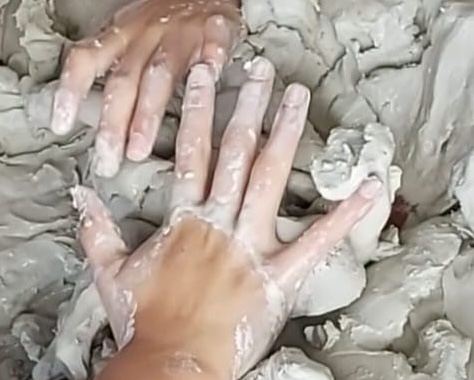
It begins with the hands.
Before words, there is touch
Long before children can explain their feelings, they understand the world through the body.
They reach.
They grasp.
They push away.
They cling.
They explore.
They press.
They seek contact.
They test boundaries.
Touch is one of the earliest ways we learn about safety, relationship, comfort, frustration and control.
When a child meets the clay field, they are not being asked to sit still and explain themselves. They are given a real material to meet with their hands.
The clay can be pressed, pushed, smoothed, dug into, gathered, broken apart, watered, repaired and held.
This gives the child or young person a way to express and organise experience without needing to immediately turn it into language.
Why direct talking can feel too much
For some children and young people, direct conversation can feel exposing.
Questions such as “How do you feel?” or “Why did that happen?” may be too difficult, too abstract, or too close.
Some children do not yet have the emotional language. Some young people have the words but do not feel safe enough to use them. Others may have spoken many times already and feel tired of being asked to explain themselves.
Clay Field Therapy® changes the starting point.
Instead of beginning with questions, it begins with experience.
The child or young person can explore the clay. The therapist notices rhythm, pressure, movement, hesitation, energy, resistance, softness, repetition and change.
The work becomes less about demanding an answer and more about supporting the body to find expression, regulation and contact.
The clay field gives boundary
Children and young people often need freedom, but they also need boundary.
The clay field offers both.
The wooden box provides a clear edge. Inside the box, the clay can be explored. It can become messy, wet, firm, smooth, chaotic, organised, heavy or soft — but it remains held within a contained space.
This matters therapeutically.
For a child who feels overwhelmed, the box may offer structure.
For a young person who feels out of control, the clay may offer something they can influence.
For someone who feels shut down, the material may invite movement.
For someone who feels anxious, pressure into the clay may help the body begin to settle.
The clay field does not tell the child what to feel.
It gives them a place where feeling can begin to take form.
Regulation through the hands
Emotional regulation is not simply about telling a child to calm down.
A child cannot always think their way into calm. A young person cannot always talk their nervous system into feeling safe.
Regulation is bodily. It involves breath, muscle tone, rhythm, pressure, contact and relationship.
At the clay field, the hands are actively involved in this process.
Pressing into clay gives feedback.
Smoothing clay can create rhythm.
Adding water can change the sensory experience.
Gathering clay can create form and boundary.
Holding clay can bring a feeling of steadiness.
These small physical experiences can be significant.
The body begins to receive information:
there is something to meet;
there is something that responds;
there is a boundary;
there is support;
there is movement;
there is possibility.
For some children and young people, this can be much more accessible than being asked to explain what is wrong.
It is not about making art
Clay Field Therapy® is sometimes mistaken for an art activity.
It is not about making something beautiful. It is not about being creative, artistic or good with clay.
There is no expectation to produce an object.
The focus is on what happens through the hands and body as the child or young person encounters the clay.
A child might dig.
A young person might press hard.
Someone might smooth the surface again and again.
Someone might use a lot of water.
Someone might barely touch the clay at first.
All of this can be meaningful.
The therapist is not looking for a finished product. The therapist is paying attention to process, contact, regulation and the child or young person’s developing relationship with the material.
When a child finds their own hold
One of the powerful moments in Clay Field Therapy® is when a child or young person begins to find support through their own hands.
They may gather the clay.
They may press both hands around it.
They may create a mound, a wall, a hollow or a place to rest.
They may discover a way of holding that feels steadying.
This is not something that needs to be forced or interpreted too quickly.
The importance is in the experience.
A child who felt scattered may begin to gather.
A young person who felt guarded may begin to soften.
Someone who felt powerless may discover strength.
Someone who felt overwhelmed may find a boundary.
The hands begin to show what is needed.
The therapist’s role
In Clay Field Therapy®, the therapist is not there to analyse the child from a distance.
The therapist is present, attentive and responsive.
My role is to support safety, notice the child or young person’s process, and stay with what is emerging. I am interested in the quality of contact, the use of pressure, the rhythm of movement, moments of hesitation, shifts in energy, and the way the child or young person begins to organise their experience.
This is gentle work, but it can also be deep work.
Children and young people need to feel that they are not being pushed into disclosure or performance. They need a space where they can explore, test, resist, repair and discover.
The clay field offers that kind of space.
Who might Clay Field Therapy® help?
Clay Field Therapy® may be helpful for children and young people who experience:
- anxiety or overwhelm
- emotional shutdown
- anger or frustration
- grief or loss
- difficulty putting feelings into words
- sensory or bodily restlessness
- low confidence or self-esteem
- stress linked to school or relationships
- developmental or relational trauma
- a sense of being stuck, disconnected or hard to reach
It may also be helpful when talking therapy feels too direct, too demanding, or not quite the right place to begin.
This does not mean words are unimportant. Often, words come later. But for some children and young people, the body needs a different starting point.
Clay Field Therapy® for children and young people in Liverpool
I offer Clay Field Therapy® in Liverpool for children, young people and adults.
For children and young people, the clay field can provide a safe, contained and developmentally sensitive space where they do not have to explain everything verbally. Through touch, movement, pressure and play, the hands are able to explore what may be difficult to say.
Parents often look for therapy when they can see that something is wrong but their child cannot fully explain it. Clay Field Therapy® can offer another way in.
No art skills are needed.
No experience with clay is needed.
There is no pressure to know what to say.
In my work with children and young people, I often meet those who have already tried to explain what is wrong.
Some can describe their feelings clearly. Others struggle to find words for what they are carrying.
What I have learnt is that emotional difficulty is not always held in language. Sometimes it is held in the body, in patterns of tension, movement, contact, and relationship.
Clay Field Therapy® offers a space where these experiences can be explored without pressure to talk, perform, or explain.
The work begins with the hands.
If your child seems overwhelmed, anxious, withdrawn, angry, or struggles to put their feelings into words, Clay Field Therapy® may offer another place to begin.
If you would like to find out more, arrange an initial consultation, or discuss whether Clay Field Therapy® may be right for your child or young person, please get in touch through simonriley.uk
Curiosity is enough to begin.